DID YOU KNOW?
↘ Biennale of Contemporary Keramics 2026
For its second edition, the Biennale of Contemporary Keramics (BCK) has grown far beyond the scale of its inaugural chapter, which took place in 2024 on Santorini. This year, spread across five historic sites in Rhodes and bringing together artists from across the Mediterranean as well as the international art scene, Where the Day Starts explores ceramics not simply as a medium, but as a way of thinking about place, memory, mythology, and cultural exchange.
Three curators worked on the 2026 edition of BCK: Loukia Thomopoulou, its founder, who has long championed ceramics through exhibition spaces and artist residencies in Athens; Stamatia Dimitrakopoulos, who focused on Greek artists; and Anissa Touati, who brought an international dimension to the biennale.
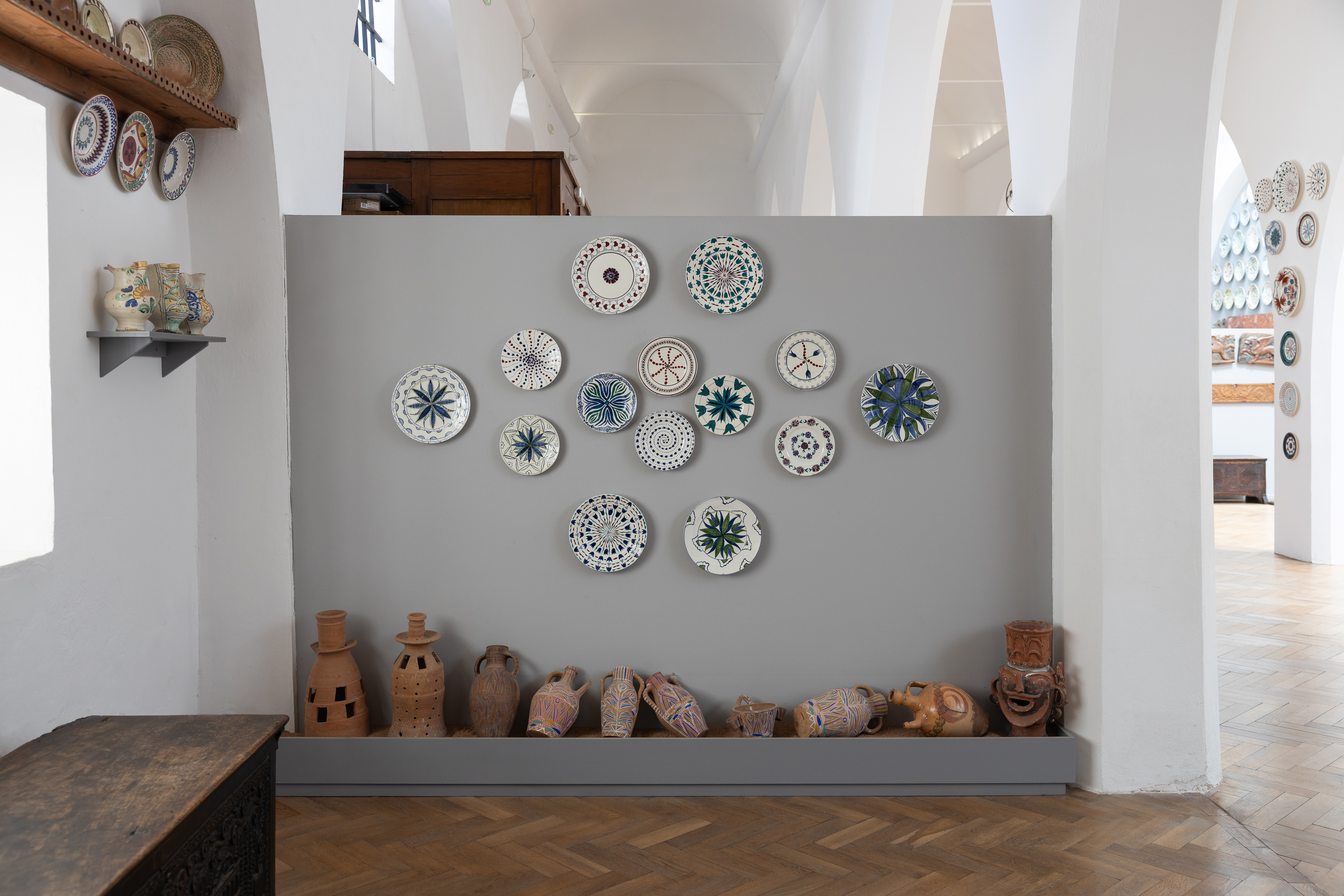
The island of Rhodes, with its rich mythology and layered history, is not only the venue for the biennale but also its central protagonist and source of inspiration. The title of BCK, Where the Day Starts, emerged from the mythology of Rhodes and the figure of Helios, the sun god. Yet the exhibition is not a literal exploration of myth. Rather, it reflects on beginnings and endings, arrivals and departures, and, most importantly, encounters—an idea that lies at the heart of the island’s history. Over centuries, Rhodes has been shaped by successive civilizations—Greek, Ottoman, Italian, French, and many others. It is almost a condensed version of the Mediterranean, where centuries of encounters, occupations, exchanges, and migrations can be read in its architecture, art, crafts, and even its cuisine.
This idea of Rhodes as a crossroads informed many of the artists’ responses. Rather than focusing solely on mythology, the works engage with broader questions of history, movement, identity, and cultural exchange across the Mediterranean region.
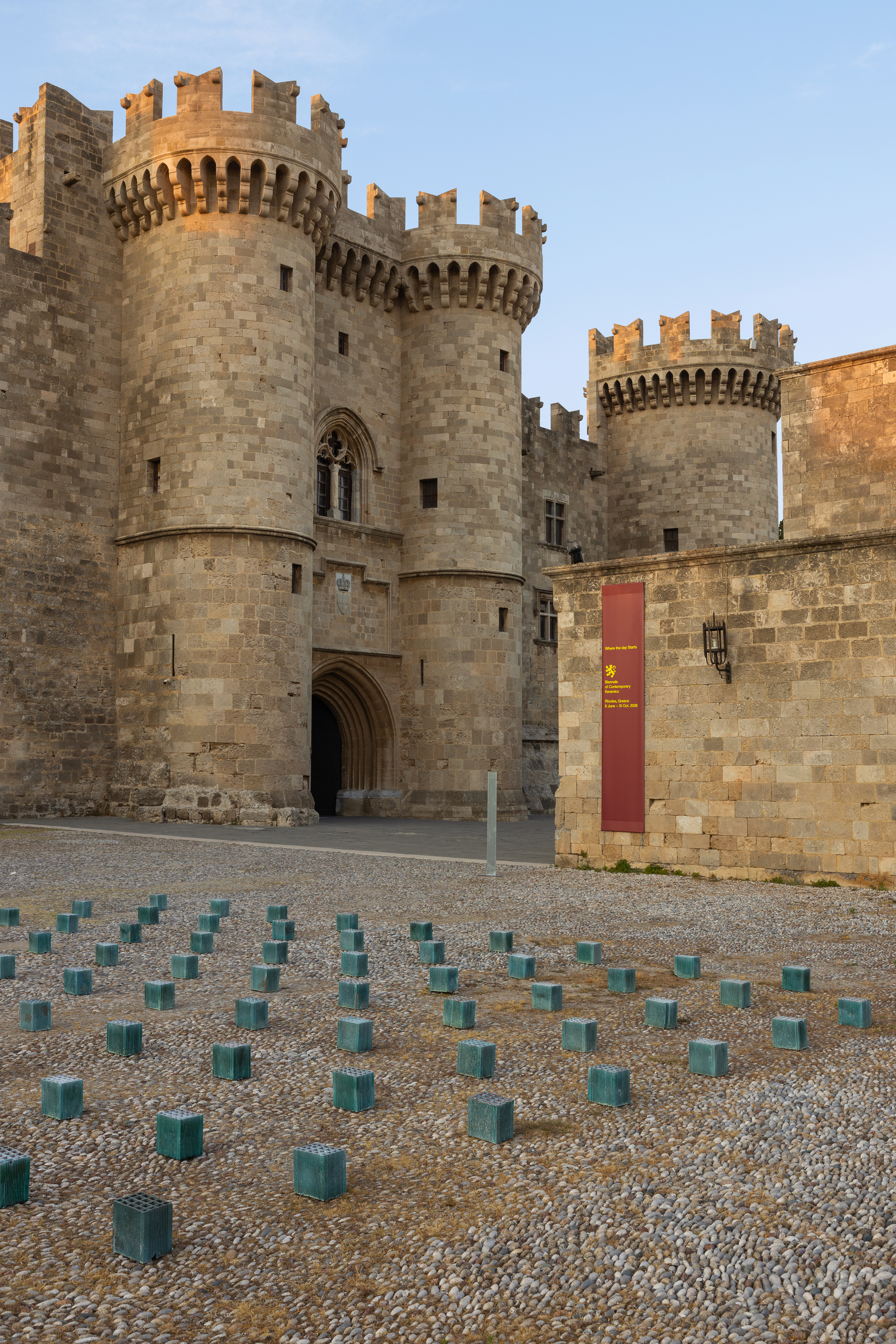
The strong presence of history and mythology is reflected in the choice of venues, all located within the medieval centre of Rhodes, as well as in the exhibition’s scenography. The curatorial team worked closely with archaeologists from the Ephorate of Antiquities of the Dodecanese, alongside museum specialists. Every installation was considered in relation to the site’s existing artefacts, architecture, and historical significance. Rather than imposing contemporary artworks onto heritage sites, the goal was to create a dialogue between different periods and to integrate the works into their surroundings, allowing them to become organic elements of the spaces they inhabit.
The exhibition combines newly commissioned projects with existing works selected through an international open call. This dual structure allows the biennale to present established artists while also creating space for unexpected discoveries and emerging voices.
The production process varied from artist to artist. Some travelled to Rhodes and worked directly with local artisans, while others conducted extensive research remotely before arriving.
Among the newly commissioned works is a project by Robert Brambora, who developed an installation inspired by both traditional Rhodian decorative culture and the island’s tourism industry. Working with a local carpenter, he created a series of furniture pieces that appear to be burning and incorporate gilded ceramic elements, reflecting on the tensions between materials, personal desires, and political realities.
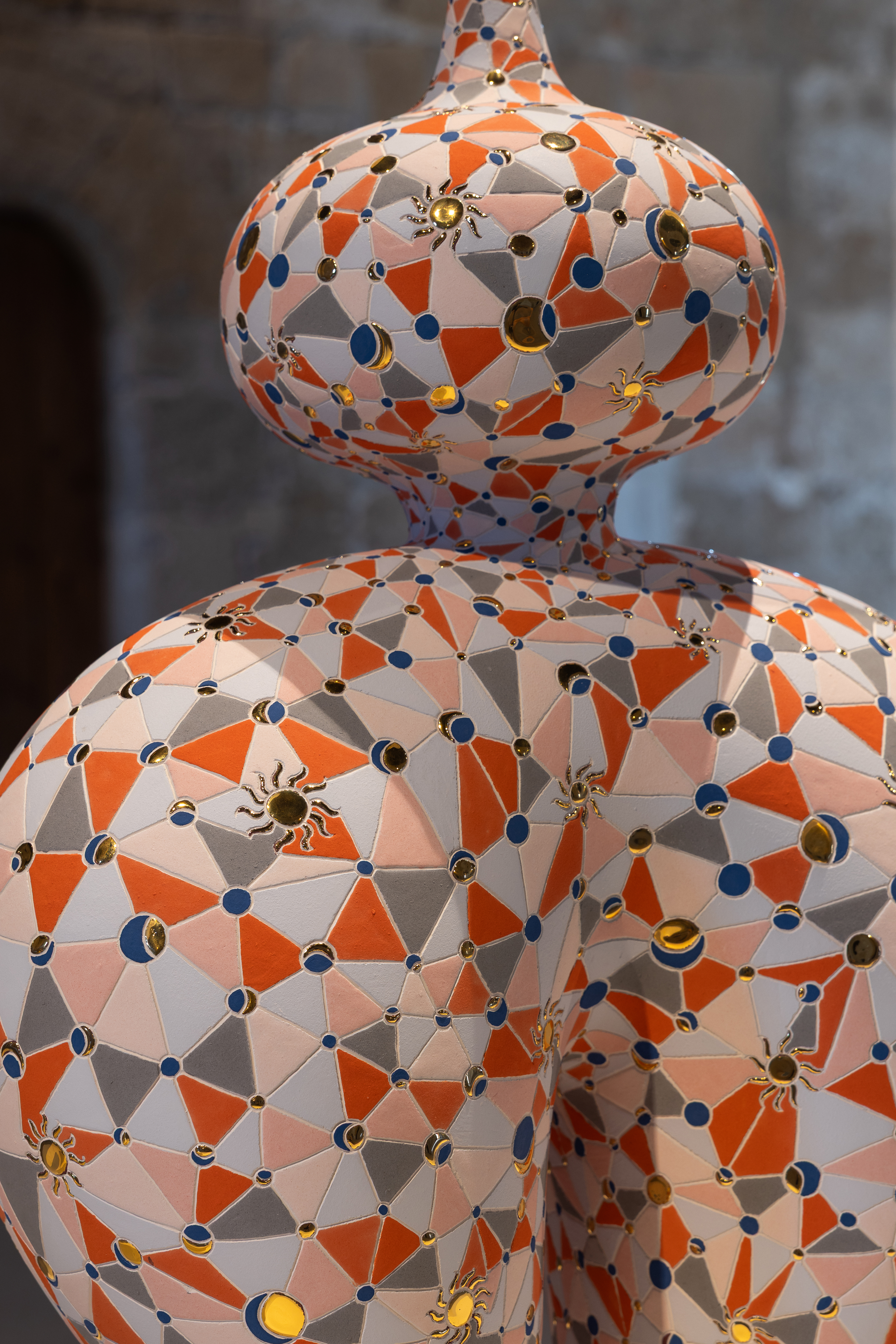
Madrid-based artist Ayla Tavares turns to the idea of the beginning of the day through the legacy of Posidonius, the philosopher and scientist who lived in Rhodes and approached the universe as an interconnected whole. Inspired by his vision of humanity as part of a larger cosmic continuum, her Materia Materia series connects geological, astronomical, and historical time into a shared narrative of interconnected worlds.
Tunisian artist Malek Gnaoui spent time on the island working with a local ceramic workshop to create a series of columns inspired by both Roman remains in Carthage and contemporary Mediterranean architecture. Installed in dialogue with archaeological structures, the work blurs distinctions between ancient forms and present-day realities.

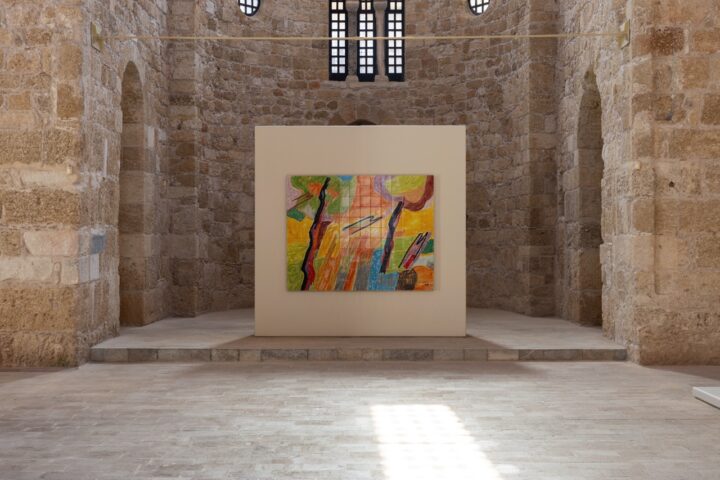
Philosopher Mohamed Amer Meziane engages with a landscape by Etel Adnan through a reading of a text on the sun and the way it enters philosophy, destabilising the widely accepted coordinates between the East, where the sun rises, and the West, where it sets.
The Biennale benefits from a parallel programme and a series of satellite exhibitions hosted in some of the city’s most distinctive architectural venues. One of these is the Auberge de France, which presents Zoë Paul’s solo exhibition, Requiem to Throwing Water. The exhibition features monumental curtains composed of thousands of ceramic beads, produced in collaboration with ceramists and members of the public, who were invited to participate in a performative workshop during the exhibition’s opening.
BCK uses ceramics less as a subject than as a meeting ground. Across archaeological sites, churches, museums, and public spaces, Where the Day Starts brings together artists from different countries and generations to reflect on a region whose histories remain deeply intertwined.
A nomad biennale, BCK will travel to another Greek island in 2 years, reinventing itself with every edition.